Owed?
Track personal debts and payments without spreadsheets or awkward reminders.
Tagline
Track personal debts without the chaos
The simplest private debt tracker for personal IOUs.
Stop guessing who owes you and how much.
Built for one-to-one debts, not group expenses.
The simplest private debt tracker for personal IOUs.
The product is intentionally stripped down to the core workflow: add person, log debt, record payment, view balance. That makes 'simple + private' the most credible category-defining message.
The alternative to spreadsheets, notes apps, and 'I'll remember later.'
The landing page explicitly positions against mental math and the need for manual tracking. Competing against informal tools is more believable than trying to out-feature finance apps.
Stop guessing who owes you and how much.
The page repeatedly emphasizes clarity, overdue visibility, and balance-at-a-glance reporting. This is a pain-killer angle focused on eliminating ambiguity and follow-up anxiety.
Primary user
Individuals casually lending money to friends, roommates, coworkers, or family members who need a simple way to remember who owes them
ICP #1
Freelance designer or contractor who occasionally fronts expenses for clients or friends
Pain
They forget small debts, lose track of partial repayments, and don't want to maintain a full invoicing or accounting system for casual money owed
Why this solves
Owed? gives them a fast way to log a person, a balance, and payments without the overhead of invoices, projects, or bookkeeping fields
ICP #2
Roommate or household organizer who pays shared costs and needs to track informal reimbursements
Pain
They end up with scattered notes, text messages, and mental math when someone says 'I'll pay you back later'
Why this solves
The dashboard makes balances and overdue amounts visible in one place, so they can stop relying on memory and message threads
ICP #3
Someone who regularly lends small amounts to friends or family and hates awkward follow-up conversations
Pain
They avoid asking for money back because they don't have an exact record of what was lent, repaid, or still outstanding
Why this solves
Owed? creates a simple, private ledger of who owes what and what has been paid, making reminders less ambiguous and more defensible
Strengths
- +The value proposition is instantly understandable in one glance: track who owes you money.
- +The product is framed around a concrete, low-friction workflow, which matches the likely use case well.
- +The page reduces purchase anxiety with 'Free to use. No credit card. Works on web and mobile.'
Weaknesses
- −It is too generic and could be mistaken for a placeholder; there is no sharp differentiation from Splitwise or a spreadsheet.
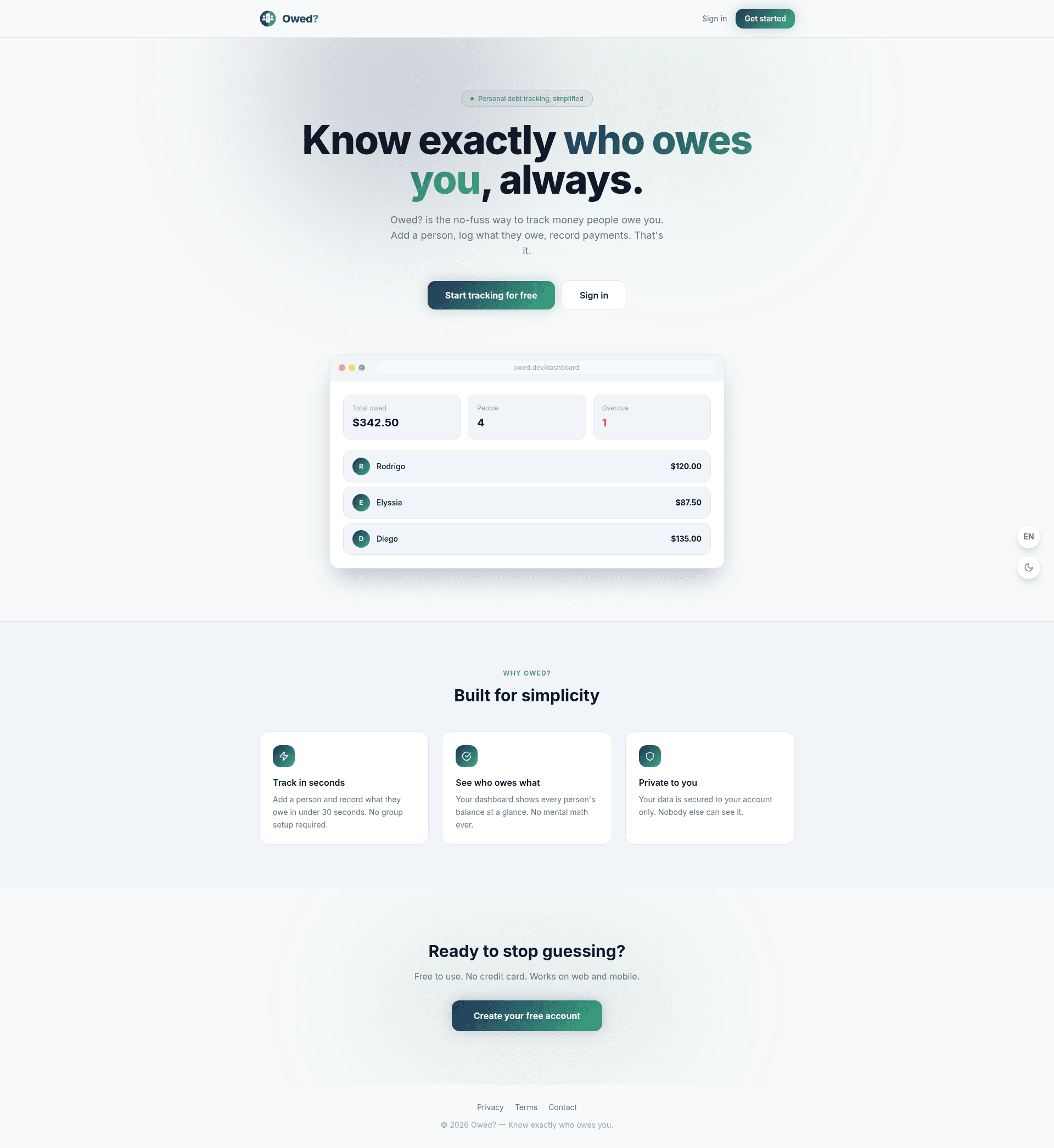
- −There is no proof: no screenshots beyond a tiny dashboard mock, no testimonials, no numbers, no trust signals.
- −The copy does not clarify the edge case it owns: personal IOUs, informal lending, or lightweight debt tracking outside group expense splitting.
- −The page never explains why a user should choose this over a notes app, spreadsheet, or Splitwise for one-to-one debts.
- −The brand voice is so minimal that it risks sounding unfinished rather than intentionally simple.
Fix these
- Add a 'built for one-to-one debts, not group expenses' message above the fold to carve out a clear niche.
- Show real UI screenshots with the dashboard, add-person flow, and payment history so users can understand the workflow immediately.
- Add concrete use cases like 'loaned a friend $120,' 'covered rent,' or 'fronted a coworker's ticket' to make the product feel real.
- Include trust and retention cues such as privacy details, data export, or what happens if a person partially repays.
- Create a direct comparison section versus Splitwise, Google Sheets, and Notes apps to explain why this tool exists.
Drop-in replacement copy
Headline
Track personal debts without spreadsheets
Add a person, log what they owe, record payments. That’s it.
See who owes you at a glance
Your dashboard shows total owed, how many people you’re tracking, and what’s overdue. No digging through chats or notes to figure out the real balance.
Log debts and payments in seconds
Add a person, record what they owe, then attach payments as they happen. Partial repayments stay visible, so the balance always stays current.
Built for private, personal IOUs
Owed? is for one-to-one debts, not group expenses. Your data stays account-only, so your lending records stay private.
Works wherever you need it
Use Owed? on web or mobile, whenever the debt comes up. It’s free to use with no subscription or credit card.
FAQ
Is this for splitting bills with friends?
Not really. Owed? is built for personal IOUs and informal lending, not group expense splitting. If you want a one-to-one debt tracker, this fits.
Can I track partial payments?
Yes. You can record payments against a person’s balance, so the remaining amount stays accurate.
Is my data private?
Yes. Owed? is account-only data, so your debt records are private to you.
Do I need a credit card?
No. It’s free to use and you do not need a credit card to start.
What’s the difference from a spreadsheet or notes app?
Owed? keeps balances, payments, and overdue items in one place automatically. You don’t have to do the remembering or the math yourself.
Spreadsheet debt tracking is terrible. So I built Owed? for the stuff people actually lend each other: • $40 for dinner • rent you covered • a quick favor that turned into a tab Add a person, log what they owe, record payments. That's it.
I kept forgetting small debts. Not huge invoices. Just the annoying little IOUs that live in texts, notes, and your brain. So I made Owed? - a private ledger for personal money owed. If you’ve ever thought “I’ll remember later,” you know why this matters.
Awkward reminders cost money. When you don’t know the exact balance, you wait. When you wait, you write it off. Owed? makes it obvious who owes what, what’s been paid, and what’s overdue. Less guessing. Fewer weird texts.
Watch this debt disappear: 1. Add Sarah 2. Log $120 she owes you 3. Record her $40 payment 4. See the balance update instantly No spreadsheet. No invoice. No group expense junk. Just a clean list of people and what they owe.
People don't want accounting apps. They want to know: • who owes them • how much is left • whether anything is overdue That’s why Owed? stays minimal. If your debt tracker needs a tutorial, it’s already too much.
Built for one-to-one debts only. Owed? is not trying to replace Splitwise. It’s for the simpler mess: • friends • roommates • family • coworkers Private account-only data. Web and mobile. Free to use.
The best UX is fewer fields. For Owed? I cut everything that didn’t help with one job: track personal debts. Add person. Add amount. Record payment. See balance. If a product can be this small and still useful, that’s a win.
Notes apps are not ledgers. They don’t show balances. They don’t show overdue items. They don’t tell you who’s paid what. If you’re still tracking IOUs in notes or chats, Owed? is the boring fix that makes the mess visible.
Here’s the whole workflow: Add a person Log what they owe Record payments Check the dashboard That’s the product. No projects. No invoices. No split calculations. No subscription. Just a fast way to remember money people owe you.
Free tools should be boring. Owed? is free, private, and built for the kind of debts people usually handle with memory and screenshots. If you’ve ever needed a simple list of who owes what, this is for you. Link in bio.
Angle: why this exists: personal IOUs are messy
Most people don’t need a full finance app. They need a way to remember: who owes them, how much, and whether anything was paid back. That’s why I built Owed? It’s a private debt tracker for personal IOUs - the tiny loans, reimbursements, and “I’ll pay you back later” moments that get lost in notes, texts, and memory. The workflow is intentionally blunt: Add a person. Log what they owe. Record payments. See the balance. That’s it. No invoices. No split-group complexity. No accounting language. I kept seeing people use spreadsheets for this, which works until it doesn’t. One partial payment, one forgotten note, one awkward follow-up, and the whole thing turns into a mess. Owed? is the boring fix. Private account-only data. Web and mobile access. Free to use. If you’ve ever lent money and thought “I should write this down,” this is for you.
Angle: positioning against spreadsheets and Splitwise
I think a lot of products fail because they try to be the biggest tool in the room. For Owed?, I went the other direction. It’s not for splitting dinner with six friends. It’s not for full invoicing. It’s not for bookkeeping. It’s for one thing only: tracking personal debts between people. That matters because the real alternative is usually not another app. It’s a spreadsheet, a Notes doc, or a message thread with “I’ll remember later.” And that’s where things break. The balance gets fuzzy. Partial payments get lost. The overdue amount becomes a guess. So the product is simple on purpose: • dashboard total owed • number of people tracked • overdue items at a glance • per-person balances • payments recorded against the balance I’d rather make something small that gets used every week than something broad that gets opened once. If you’ve ever tried to manage casual IOUs without a system, you already know why this exists.
Angle: minimal product philosophy and trust
There’s a kind of product that gets better by adding more features. And there’s a kind of product that gets better by removing the wrong ones. Owed? is the second kind. When people lend money casually, they don’t need workflows. They need clarity. Who owes what. What has been paid. What is still outstanding. So I kept the app deliberately minimal: Add a person. Record a debt. Log a payment. Check the dashboard. I also made privacy a default, not a checkbox. This is account-only data. It’s not a shared group ledger. It’s your personal record. The goal wasn’t to build the most impressive finance product. The goal was to build the one you’d actually open when someone asks, “Did I already pay you back?” If that sentence sounds familiar, Owed? is probably for you.
Tagline
Track personal IOUs without spreadsheets
Description
Owed? is a private debt tracker for personal loans, reimbursements, and casual IOUs. Add a person, log what they owe, record payments, and see balances at a glance on web or mobile. Free, simple, account-only.
Maker's first comment
I built Owed? because I was tired of tracking small debts in places that were never meant for it - Notes, DMs, screenshots, and one very messy spreadsheet. The problem was never the math. It was the friction of remembering who owed what, whether they had paid partially, and how to follow up without sounding awkward. A lot of debt apps are built around group expenses. That’s useful, but it’s not the same thing as one person owing you $40 for groceries, $120 for rent, or a small reimbursement that lingers for months. I wanted something that stayed out of the way and made the answer obvious at a glance. So I kept the workflow tiny: add a person, log what they owe, record payments, and check the balance. No invoices, no clutter, no account setup headache. It’s free, private, and works on web and mobile. I’d love feedback on whether the positioning is clear enough: does it feel distinct from Splitwise, spreadsheets, and notes apps? And if you’ve used it, what’s the one thing that would make you trust it for real debts?
Pinned maker comment
Would love feedback on the clarity of the use case: does “personal IOUs, not group expenses” read instantly?
Meta
Still tracking IOUs in your notes app?
Hypothesis: people who casually lend money to friends, roommates, or family want a private, dead-simple ledger more than a full finance app. Owed? lets you add a person, log what they owe, and record payments so you can stop relying on memory, texts, or spreadsheets.
Google Search
Track who owes you money
Hypothesis: users searching for a personal debt tracker want a simpler alternative to spreadsheets and Splitwise for one-to-one debts. Owed? is a private app for personal IOUs. Add a person, record what they owe, and see balances and overdue items at a glance.
Reddit Promoted
If you’ve ever said “I’ll remember later”
Hypothesis: founders and personal finance minimalists in Reddit communities hate overbuilt money apps and want something focused on casual debts only. Owed? tracks personal IOUs without spreadsheets or awkward reminders. It’s private, free, and built for one-to-one debts, not group splitting.
Subreddits
r/SideProject
Build story + demo: why you made a tiny private debt tracker instead of another finance app
Rules: Share the process and product; avoid spammy sales language; include screenshots or a short demo clip.
r/indiehackers
Launch story and lessons learned building a niche utility for a very specific pain
Rules: Discuss the build, the positioning, and what you learned; avoid pure promotion without context.
r/microsaas
Small utility product for a narrow use case: personal IOUs and informal lending
Rules: Keep it founder-focused, share the niche and stack/process, and don’t overpost the link.
r/EntrepreneurRideAlong
Public build log: from noticing a messy personal problem to shipping a tiny paid-free tool
Rules: Be transparent, practical, and story-driven; avoid dropping a link without background.
r/personalfinance
Ask for feedback on a lightweight way to track informal loans and reimbursements
Rules: No hard promotion, lead with the problem and ask for input; be careful not to sound like advice spam.
Communities
Post a build breakdown, then reply in threads where people ask about micro-SaaS positioning, onboarding, and retention.
Engage before launch with other makers, comment thoughtfully on launches, and ask for genuine product feedback rather than votes.
Bootstrapper / micro-SaaS Discord groups
Share short demos and ask for copy feedback. Offer to review other founders' landing pages first so you earn attention.
Cold outreach template
{firstName}, I built Owed? because I kept losing track of small personal IOUs and reimbursements in notes and texts. I thought you might care because {context} and this is the simplest way I’ve found to track who owes what without spreadsheets. If you want, I can send you a 30-second demo.
Product Hunt timing
Launch on Tuesday at 12:01 AM PT. That gives you the strongest full-day window for US makers and Product Hunt’s core audience, while avoiding weekend noise; for this ICP, weekday mornings are when people notice small utility tools they can immediately use.
Indie Hackers post ideas
- 01I built a tiny app for personal IOUs instead of another finance tool
- 02How I positioned a debt tracker for one-to-one debts, not group expenses
- 03What I removed to make a boring app people can actually understand in 5 seconds
Competitor alternatives
Current tone of voice
Minimal, friendly, and anti-complexity, with direct copy like 'Add a person, log what they owe, record payments. That's it.'
Your kit is ready. Sign up free to unlock, takes 10 seconds.
7 more X posts · 2 LinkedIn · Product Hunt copy · ad hooks · 100-user playbook · landing critique